
Part 3: When the Loop Snaps
Overbuild, circular money, and the fragility beneath the AI boom that are compressing a 60‑year cycle into just a few.


Third chapter of an ongoing series. Find Chapter 1 [here], Chapter 2 [here].
I want to be honest with you about something before we start.
I’ve worked in venture capital. I sat in rooms asking about valuations, traction, and revenue like they were real, like the numbers meant something beyond the story we were all agreeing to tell each other. But with early-stage startups, especially in AI right now, they often don’t. Revenue can be subsidized, growth can be driven by hype, and valuations are mostly bets on what might happen, not what exists today. For a while, I believed it. Or maybe I just didn’t ask enough questions.
I’ve been asking them now.
This series started as an intellectual exercise, a historical comparison, a framework to make sense of what’s happening in AI. But somewhere along the way, it became more personal. People around me started asking what they should do with their money, and I realized I didn’t have a clear answer. It’s hard to plan anything right now: everything is expensive, the job market is tight, and even basic things feel less certain than they used to.
So that’s what this chapter is really about. Not just the data (though we’ll get into it) but the question underneath the data: what do you actually do when you suspect the thing everyone around you is excited about might be the trap?
I don’t have a clear answer. But I think it’s worth digging into…
—
A few weeks ago, three things happened in quick succession that made me realize it’s happening now.
First, Iran blocked the Strait of Hormuz, one of the most important energy corridors in the world. Oil jumped more than 50% almost overnight. The US responded with a 48-hour ultimatum. I read the headlines a couple times because it didn’t feel real!
I kept thinking this isn’t just a geopolitics story. It’s a reminder that underneath all our talk about software and intelligence and the cloud, the world still runs on physical things. Energy. Metal. Infrastructure. And AI is one of the most physically hungry techs we’ve ever built. It runs on electricit, chips, rare earth materials, copper wire, water for cooling. Things that come from the ground.
Then, Nvidia pulled back. Remember that $100 billion investment in OpenAI everyone was talking about? Apparently it’s looking more like $20-30 billion now. And they made sure to keep it quiet, shrinking the numbers when we were not paying attention. It’s never good news when the investors closest to the machine start quietly adjusting their exposure. It means people on the inside are starting to rethink things.
And then Michael Burry, the guy who famously bet against the housing market before 2008, the one they made a movie about, published a long note about U.S. Market Structure & Value Powerful Trends, Increasing Fragility & Coiled Tension. He compared this moment to the 1920s radio boom. RCA went up 200 times. Then lost 98% of its value. His main question:
AI data center spending — when does it actually stop?
1. We Are Building Ahead of Demand. Again
Here’s something they don’t teach you in finance school, but that you figure out pretty quickly once you’ve watched enough cycles up close:
The most profitable thing in any boom isn’t using the tech. It’s building it.
During the railroad era, the men who got rich weren’t always running profitable railways. They were building them, collecting land grants, issuing bonds and taking a cut from construction deals. The trains themselves almost didn’t matter. The money was in building, in the story of progress, and in raising the next round of funding.
I think about that a lot when I look at what’s happening right now.
McKinsey estimates about $5.3 trillion will go into AI infrastructure over the next decade. To put that in perspective, that’s more than what the entire US interstate highway system cost over 40 years (adjusted for inflation).
But what are we building that we don’t actually need yet?
By 1890, there were five transcontinental rail lines when the market could maybe support two. Companies built parallel routes aiming at the same customers. And eventually prices fell below the cost of operation (which is obviously never good)
Model prices in AI have already started falling, down more than 30% annually. In every big spending cycle, supply comes first. Prices fall, and then demand follows. If it follows. That last part is where people tend to look away.
95% of generative AI pilots never make it into real production. Companies run tests, allocate budgets, hold demos, and then most of it just stalls. The tools don’t fit how people actually work. Or they’re used by fear of being left behind more than any genuine need. I’ve seen this pattern in VC. I’ve been in those rooms too. I know what that looks like.
And yet the hype keeps going. ChatGPT hit 100 million users in two months. Faster than Instagram, Spotify, or Netflix. But fast user growth doesn’t always mean real demand. Sometimes it’s just curiosity. And curiosity doesn’t pay the bills.
We’re building at an extraordinary pace for use cases that are still, largely, taking shape. Infrastructure often precedes demand. But this is a very large, very expensive bet. And most of the people making it are doing so with other people’s money.
2. The Loop… And Why It Makes Me Nervous
Let me try to explain something that took me a while to fully see, even working inside this world. There’s a financing structure behind the AI boom that looks clean on the outside, but is actually a little unsettling once you trace it all the way through.
Nvidia puts money into OpenAI. OpenAI uses that money to build data centers. A huge chunk of that data center spending goes back to Nvidia (for the GPUs that power everything). Nvidia books the revenue. Its valuation goes up. More investors pile in. More money flows. The loop continues.
At one point, Nvidia’s commitment was close to $100B. Even if it’s really $20-30B, capital still goes in one end and comes back out the other. Revenue looks strong, valuations look justified, and from the outside, it looks like an industry on fire.
I’ve seen versions of this before, obviously smaller. A startup that’s technically growing revenue, but most of it is coming from investors who are also customers, or partners who have a stake in the outcome. It feels real and then it’s usually too late to get out cleanly.
The CFA Institute has flagged this: these connected money flows distort the revenue signals and make it genuinely hard to tell how healthy things actually are underneath. Across the whole ecosystem, analysts estimate close to $1 trillion in related commitments bouncing around between the same players.
Meanwhile, something was happening in the shadows. Free cash flow at the biggest tech companies started shrinking in 2025. To keep spending on AI up, they began borrowing: Oracle, Meta, and Alphabet all raised tens of billions in debt. Stock buybacks, which had quietly supported equity prices for years, pulled back because the cash was going elsewhere.
In early 2026, OpenAI raised $110 billion at a $730 billion valuation. Amazon, SoftBank, and Nvidia all contributed. I had to reread that number: $730 billion. For a company that doesn’t expect to break even until 2029 or 2030, and where, by one analyst’s estimate, every ChatGPT conversation still loses money.
When asked about the circular financing concern, OpenAI’s CEO basically said it works as long as real value is being created and revenue keeps growing.
And then the longer I stared at this particular loop, the more it reminded me of something else: The way large pools of capital can quietly hide risk.
—
That’s when I came across Nick Nemeth. He doesn’t own a fund, no institutional backing, no team, no office. He’s Just this one person, with a laptop and a stack of public SEC filings that apparently nobody with actual power and resources had bothered to read carefully enough.
He wrote an open letter to Treasury Secretary Bessent. The subtitle alone made me stop: On private credit, pension exposure, and the nearly $13 trillion question.
Here’s what he found, and why I think it connects directly to everything we’ve been talking about.
Private equity now manages about $9.4 trillion, and private credit has grown to $3.5 trillion : almost double what it was 2 years ago. That’s a huge amount of money, and it plays a big role in how AI gets funded and which startups survive. The tricky part is how this money is valued. These firms often decide the value of their own investments. They also hire the people who review those numbers, and their fees depend on those valuations. So a lot of it happens behind closed doors, with very little outside oversight.
Nemeth focused on one fund: Cliffwater Corporate Lending, a $31.5 billion private credit fund, one of the largest in the US. He went through it loan by loan, looking for inconsistencies.
Officially, the fund reported that less than 1% of its loans were in trouble. But Nemeth found nearly 200 loans where borrowers had stopped paying interest in cash and were instead adding it back onto the debt. Over 50 loans that should have been marked as non-performing weren’t. The fund had also never reported a losing month… 41 months in a row!
The numbers were almost too perfect. Real investments don’t behave like that. Risk shows up, unless the numbers are being smoothed.
Then there’s the bigger question: where does the money come from?
A large part of the capital flowing into private credit, and into AI and venture more broadly, comes from pensions, 401(k)s, and retirement savings. People who have no idea what a unitranche loan is. About $718 billion of US pension money is tied up in private equity and private credit. In Oregon, nearly 27% of the public pension is allocated there.
I think about specific people. My parents, who saved consistently. A friend’s mom, a retired teacher, who has no idea part of her pension sits in a fund that has never reported a losing month in years, and whose loans, at least to one careful reader, look like they’re hiding something. She didn’t choose this. Her pension board did. The fees collected along the way don’t come back, they never do.
Nemeth’s warning is simple. Valuations drive fees. Fees come from pensions. Pensions come from paychecks. When the cycle turns, it won’t be the fund managers or the valuation agents taking the hit. It’ll be the teachers, the firefighters, the nurses.
He ends his letter with two scenarios. First: 2008. Fast, ugly, painful, but visible. Everyone sees the problem, and eventually the system heals. Second: Japan. Twenty years of slow decay, with crises that never get connected. A slow rot, visible in filings all along, if anyone had looked.
3. The Physical World Keeps Showing Up
Here’s something else I’ve been turning over for a while.
We talk about AI like it’s made of ideas. It kinda is, it’s math, patterns, prediction. But the infrastructure it runs on is as physical as anything the railroad entrepreneurs built. Maybe even more
Data centers consume enormous amounts of copper for power distribution, for cooling systems. Aluminum. Rare earth elements. Water. And semiconductors, which require some of the most energy-intensive and material-intensive manufacturing processes humans have ever developed. I’m not gonna get into it now but smiconductor manufacturing electricity is equivalent to the annual consumption of a mid-sized country… It’s insane.
Last week I was taking a walk and saw a bumper sticker on a car: “The cloud is made of metal” it made me smile cause it’s true!
In 2025, copper prices hit record highs. Silver went even higher. And investment in new mining and processing? Actually down in real terms after inflation. We are pouring trillions into the top layers while the foundation barely gets any investment.
This really matters because China controls most of the processing of rare earth elements (materials that go into basically every advanced piece of tech you can name). We call that leverage. We’ve already seen export restrictions used as a bargaining chip in broader geopolitical tensions. The Strait of Hormuz situation is a reminder that physical chokepoints are still very much a thing, no matter how much of our economy feels digital.
4. Where Does the Money Actually End Up?
This is the question I’d ask in every investment meeting, and I’m going to ask it here.
It’s not weather AI real. It is. Not “is there value being created?” There is. The question is: where does it land, and who ends up with it?
Back in the railroad days, money didn’t stay in one place. Early winners were the builders, land speculators, and financiers closest to the construction frenzy. Over time, the real profits moved to those who controlled grain elevators, terminals, and land along the routes. The railroads themselves were buried in debt, running too many trains and became low-margin, unwanted businesses. Most people who just held on lost money. The ones who did well asked a different question: “Where is the value actually going?”
AI is following the same pattern, but faster. As I see it there are 4 layers:
The infrastructure layer — Nvidia, the cloud giants, the data center builders. The names you’re hearing everywhere right now. Nvidia’s data center revenue topped $50 billion in 2025, with profit margins above 70%. Cloud providers committed $320 billion to AI infrastructure in a single year. The numbers are hard to process.
But being first to build has never guaranteed lasting profit. Vacancy rates in some US data center markets actually doubled in a year. Model prices are falling 30% annually. The overcapacity isn’t obvious yet… but I believe it’s coming.
The model layer — OpenAI, Anthropic, a handful of others. This is where the biggest bets are right now. Together, OpenAI and Anthropic capture 85% of all revenue among AI-native companies! That kind of concentration looks like a moat, until you realize network effects can go the other way too. If things start to shrink, what looked like strength can turn into one big point of failure. The growth is real (OpenAI crossed $4 billion in revenue, up from $1.6 billion a year earlier). Hard to argue with that.
But profitability is another story. Training the biggest models costs $100 million or more per run. The economics of actually serving them at scale are often still hidden. By most estimates, OpenAI loses money on every single ChatGPT conversation. And they don’t expect to break even for another four or five years.
Hmm. Four or five years is a long time to be bleeding cash at this scale… and that’s the optimistic scenario!
The application layer — I think that’s where the real value eventually lands. The companies that turn AI into tools people actually use, in ways that really change how work gets done. Howard Marks frames it well: Level 1 AI helps you think, Level 2 works alongside you, Level 3 just... does it. If Level 3 becomes real (it’s coming), the value shifts away from the model companies toward whoever builds the things running on top of them.
A few of those will be enormous. Most will fail. Same pattern as every platform shift before this one (the internet, mobile, cloud…)
And then there are the incumbents — Microsoft, Google, Amazon. They have something startups can’t buy: decades of customer relationships, proprietary data, and balance sheets that don’t require outside money to survive a crash. When I was in VC, we used to talk about “distribution moats” like they were one factor among many. I think about that differently now. Distribution might be the factor in what’s coming.
Startup funding fell 35% in Q4 2025 from its peak. The IPO market for AI is basically frozen. The circular loop (investors fund startups, startups buy compute, cloud providers book revenue) is starting to crack. The ones that survive will need a real reason to exist, real margins, and enough runway to survivre through the correction.
I’ve watched companies that didn’t have those things and it’s not pretty.
5. A Fragile Macro Structure
Michael Burry doesn’t get everything right. But he has a gift for seeing structural fragility that other people mistake for stability. In his March 2026 note his argument starts with something most people don’t think about: the plumbing of the market itself and let me try to walk you through his argument, the way I understood it.
First, where does the money that buys stocks actually come from? For most of the 20th century, it came from humans making decisions. Fund managers, analysts, people running spreadsheets and forming opinions. They were always wrong, but they were thinking. They were doing price discovery (figuring out what something is actually worth).
Then it changed. In 1978, Congress created the 401(k). Retirement systems became automated, contributions were routed directly into markets, and index funds became the default. Gradually, investing shifted from active decision-making to continuous, rule-based flows. Today, a large share of equities is effectively bought on autopilot.
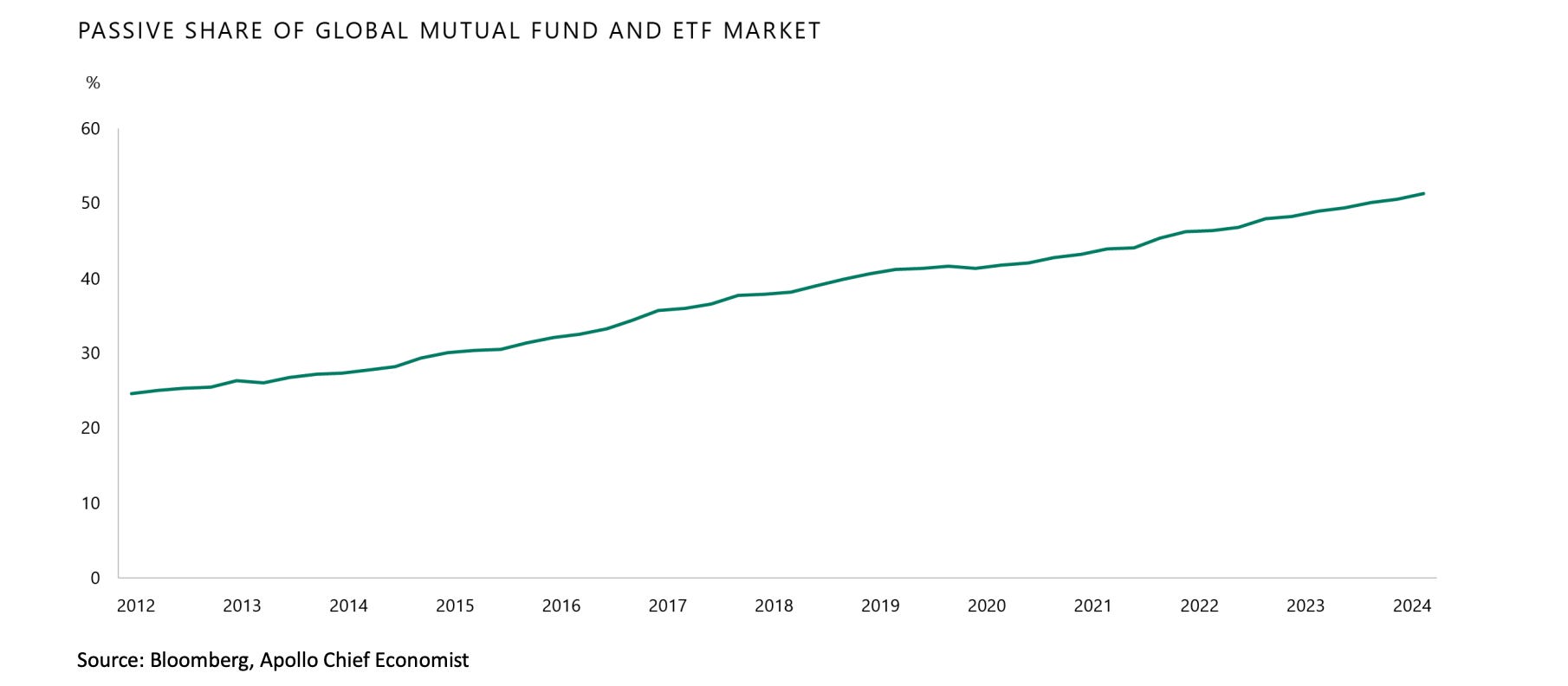
The result: today, index funds hold over 50% of equities, and most of it moves on autopilot.
Graph 1 - Passive investing now makes up over 50% of global equity mutual funds and ETFs
Here’s where it gets interesting. These index funds are weighted by market cap, so the bigger a company, the more of your money automatically flows into it. Which makes the company bigger. Which means more money flows in. Which makes it bigger still. Nobody is asking whether the price makes sense. The machine just... buys.
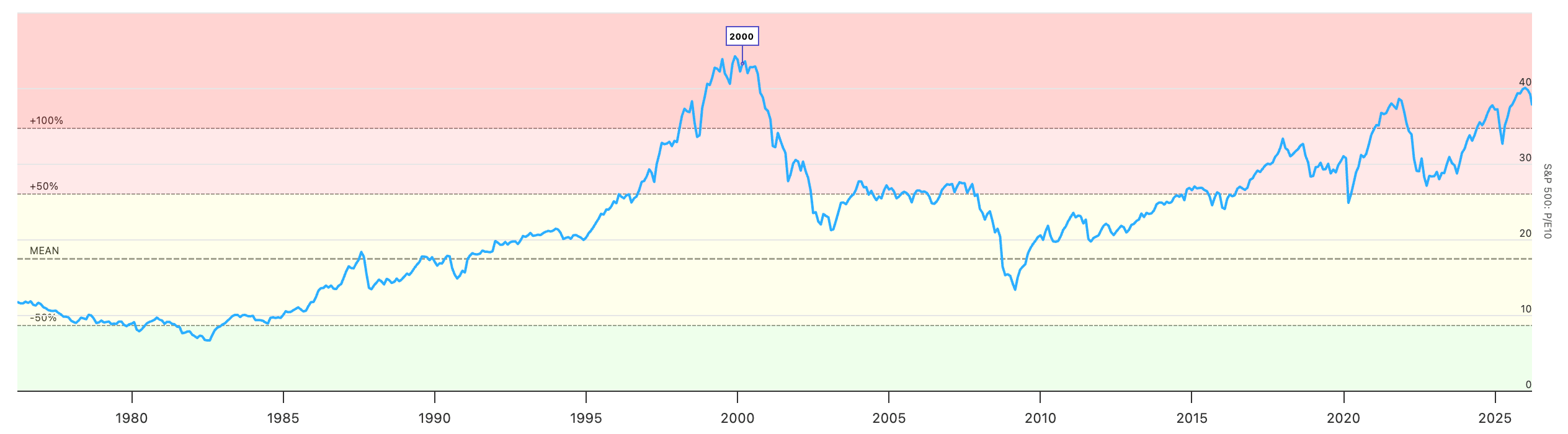
This is why the Shiller CAPE ratio, which compares current stock prices to historical earnings, is so alarming. At 40.2x, it’s almost exactly where the dot-com bubble peaked in 2000. Even more interesting: the market hasn’t touched a normal valuation in 34 years… more than three times the previous record! This isn’t just a bull market. It’s a multi-decade stretch far above historical norms, propped up by forces that have never been tested by a serious reversal.
Graph 2 - The Shiller CAPE Ratio
Now let’s add another layer. High-frequency trading firms handle around 60% of all trades today. In calm markets, they make everything run smoothly. Lots of buyers and sellers, tight spreads, liquid. But they don’t HAVE to stay. When things get rough, they vanish. Instantly. No warning, just gone. During the “Liberation Day” crash of 2025, their liquidity disappeared in minutes. What started as a routine sell-off became something much worse, much faster than anyone had modeled for. Burry noted that Liberation Day was, by real dollar value destroyed, the worst acute crash in history. Not 1929 or 2008. 2025.
Then there are the pod shops (multi-strategy hedge funds like Citadel and Millennium, managing close to a trillion dollars combined) ans each team inside these funds operates with tight automatic rules: if losses hit a certain threshold, sell immediately, no questions. In calm markets, these teams move independently, barely affecting each other. Under stress, they all hit their limits at the same time. A trillion dollars, all selling simultaneously, rippling out across everything it touches.
This happened in March 2020. August 2024. Liberation Day 2025. Each time, faster and harder than the time before.
And now the final piece, the one that I think about most when I think about people I actually know and care about. Baby boomers built the passive investing wave. For decades, they were the engine, they were contributing to 401(k)s during their peak earning years, pouring money into index funds, quietly inflating the market from underneath. It was, as Burry puts it, a titanic and historically unprecedented shift of wealth into equities.
Now they’re retiring.
Federal law requires people to start withdrawing from retirement accounts at 73. By 2028, those withdrawals will exceed new contributions for the first time in the history of the 401(k) system. The $32 trillion sitting in retirement accounts, which has been a steady, automatic, decades-long support for markets, starts becoming a steady, automatic, decades-long drain. Burry estimates $250 billion in forced selling in 2028. Growing toward $1 trillion annually by the mid-2030s.
And meanwhile, the other supports are disappearing too:
Stock buybacks: this has been the quiet mechanism that kept the biggest companies’ share prices elevated for years and it’s changing. In Q4 2025, Amazon, Alphabet, Microsoft, Meta and Oracle combined did $12.6 billion in buybacks. That’s a 74% drop year over year. These companies aren’t buying their own stock anymore. They’re borrowing money to build data centers instead. Oracle borrowed $25 billion. Meta borrowed $30 billion. Alphabet is lining up $15 billion more.
Goldman Sachs projects that Alphabet’s free cash flow could fall 90% in 2026. Morgan Stanley thinks Amazon will have negative $17 billion in free cash flow. Bank of America says negative $28 billion. The things that held the market up: passive inflows, buybacks, cheap capital are all reversing at the same time.
Burry’s conclusion is simple, and I can’t find a good reason to disagree with it.
The market is a coiled spring, held in place by forces that are now, one by one, starting to release. When it goes, and he believes it will go, it won’t be gradual. It will be violent. More violent than Liberation Day. Potentially more violent than anything we’ve seen since 1929.
And AI, which needs cheap capital and calm markets to sustain its current valuations, will be at the center of it. I keep coming back to something he wrote near the end of the note:
“The catalyst may not be much of anything. The market might just roll over because it is time.”
What This Means So Far
After everything I just showed you… here’s how I now see the world:
A lot of what looks like strong growth in AI right now is harder to interpret than it seems. Revenue doesn’t always reflect real demand. In some cases, the system is partly funding itself, which makes everything look more solid than it actually is.
Risk hasn’t disappeared. It’s moved into private markets, where it’s harder to see and even harder to challenge. And even if AI does deliver real value over time, it doesn’t guarantee that the current winners are the ones who capture it.
Most of this is being built with other people’s money and historically, that’s when things look the safest… right before they aren’t.
Because of that, I’ve started thinking about things differently. Not perfectly, but differently:
Being skeptical of clean numbers
Following where cash actually comes from
Distinguishing real demand from subsidized growth
Then there’s the bigger thing underneath all of it.
Even the most optimistic AI productivity gains won’t fix the debt problem. The root is demographic: aging populations, locked-in entitlement spending, a shrinking ratio of workers to retirees. AI can buy time. It genuinely can’t reverse the math.
And here’s what I keep coming back to: we are borrowing money to build the thing that’s supposed to help us deal with the debt. Corporate borrowing for AI infrastructure hit record levels in 2025. The whole bet is that the returns come fast enough to justify it… Sometimes that works.
I’ve seen both. And the ones that didn’t work out always looked completely reasonable at the start. The assumptions made sense. The story was convincing. By the time something felt off, the people who put the money in were no longer the ones making the decisions.
And the people who built and financed it had already been paid!
—
Ray Dalio’s framework talks about 5 forces converging: debt, internal disorder, external conflict, natural disruption, and technology. AI is arriving as the technology force at a moment when the other four are all moving in the wrong direction simultaneously.
It could be the thing that pulls us through. I genuinely hope it is. But it wouldn’t be the first time a transformative technology arrived at exactly the wrong moment in the cycle. And more often than not, it’s the cycle that determines the outcome, not the technology itself.
Right now, that cycle looks familiar, just compressed, accelerated, and moving faster than our ability to adjust.
We’re somewhere in the middle of the AI version of the railroad boom story. And unlike the people who lived through the Gilded Age, we actually have the map. I think it’s time we start reading it.
Thanks for reading!!
Cam xx